
Recent Defamation Case Client Win: $3.2 Million
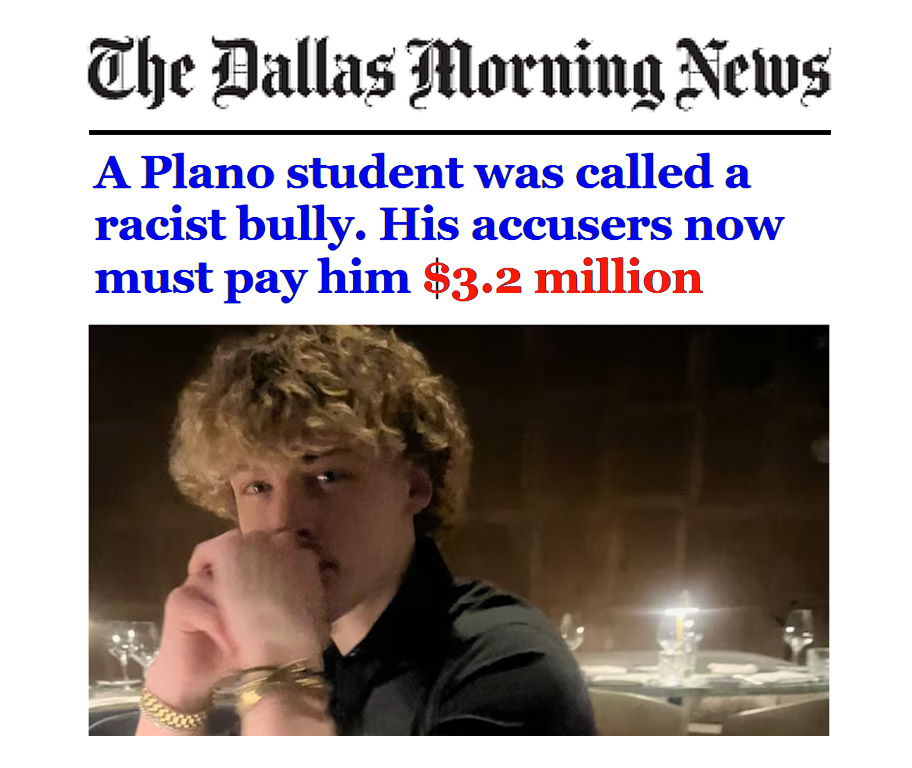
I recently testified in a court case in Collin County, Texas, where a Plano teenager had been accused of a number of crimes and misdeeds for an incident that happened in middle school — he was accused of bullying, racism, and hate crimes. The accusations were made by the mother of a boy he was friends with, as well as their attorney. The mother’s and attorney’s statements to the press were irresponsible, and because they were delivered so believably, the accusations were exaggerated and spread through news organizations and social media, reaching many millions of people and prompting outrage.
None of it was really true, although it sprang from a disgusting prank. Video interview of my client in the case, Asher Vann:
The facts of the case became thoroughly well-established, and they showed that the boy’s mother and their attorney knew that the story being related was inaccurate and that it was getting exaggerated.
The Background Story
My client invited the other boy, who is black, over for a sleepover. The boy stayed with him the first night. The next day, Asher had invited some more boys over, and they all stayed through that day and night. They roughhoused some, as boys will do — including going out and shooting each other with BB guns. The context for this part is that they were wearing coats and wanted to see if they felt the BBs through their coats. All the boys apparently participated in this, so the black boy was not singled out.
That evening, the boys collectively pulled a prank on the first boy who fell asleep — and that was the black boy. They had some apple juice, mixed some of their pee in it, woke up the boy suddenly, telling him he was having trouble breathing, so he needed to drink something. While they were giggling, one of the other boys filmed the incident on his cell phone as they tricked the boy into drinking a sip or two. He fell back asleep after, not realizing the trick. The sleepover ended without incident, and the boys went home. The boy in question was not upset and did not realize a bad trick had been pulled on him.
It was some days or a couple of weeks later that the black boy had a falling-out with one of the boys in the group, as they had a conflict over the video games they were playing. The other boy threatened to send the video of the black boy to everyone at school. Understandably upset, the black boy wanted to avoid school, and his mother thought it involved being bullied at school, and insisted he attend and that he go to the principal and make a complaint. At school, the administrator who addressed the black boy’s complaint was horrified about the video and notified the boy’s mother. She was understandably enraged and insisted that the school do something about it, and perhaps the police.
At this point, things began going off the rails. It is apparently true that the black boy had been bullied at school previously, including being called the N-word. The mother got an attorney and went to the press. The school investigated, and applied a rule to the boys involved, suspending them for a period of time and making them ineligible to play in sports. The Plano police also investigated, and found no grounds for a criminal complaint. However, the story was broadcast on the news and it quickly propagated through social media, where it was becoming increasingly exaggerated, resulting in many angry people criticizing the school district and the police department. The boys were utterly villified by the social media, and also their families were criticized and harassed.
An important aspect of the case was that the mother and attorney of the boy set up GoFundMe accounts in order to take advantage of the social media and news feeding frenzy. The donation pages described that donations would be to help the black boy receive counselling for the “bullying” he had received, and also for his education.
Subsequently, Asher Vann’s family sued the Plano Independent School District (Plano ISD), and prevailed in court because it was determined that the sleepover and the prank during it did not involve bullying. Testimony presented at that case also established that the police department had not found any illegal activities. The judge in the case found that the school district did not have jurisdiction to punish the boys for their behavior outside of the campus or official school activities.
The boys and their families were harmed by the false narrative because they were branded as racists, bullies, hate crime offenders, and much more.
The Lawsuit vs. The Mother and The Attorney
After prevailing in their lawsuit against the school district, Asher and his family turned towards suing the boy’s mother and their attorney.
I was approached to serve as an expert witness in the case by Asher Vann’s attorney, Justin P. Nichols, principal of The Nichols Law Firm, PLLC, in San Antonio, Texas.
I had significant qualms about taking the case for a few reasons. Primarily, the news media and social media about the sleepover prank were so lurid that they gave the public a predisposed negative attitude about Asher Vann, and I considered that being seen as helping him could cause members of the public to potentially tarnish my own image. I also would not work to help whitewash someone if they truly were racist and harmful to others based on racial prejudice. After reviewing the background of the case, and reading the judgment issued in the prior case versus the school district, I felt better about the case because it had been legally determined that bullying and racial epithets at the sleepover had not occurred. So, I would have a conflict of interest about representing Asher, but I was still concerned that I could be perceived badly because it is not possible to downplay the image of white boys tricking a black boy into drinking urine. Since there have been so many racially-charged incidents in America over the last ten years, people tend to ignore context and nuance in order to evaluate a story at face value. But, first and foremost, I felt I should accept the case because the plaintiff had clearly been wronged. Afterwards, as I learned more details, I know the original story that spread about the plaintiff was virtually all false.
During the course of the litigation, the mother refused to comply with some of the plaintiff’s discovery demands. Particularly, she repeatedly declined to provide information about her financial accounts and the GoFundMe donation information to Asher Vann’s legal team. The judge sanctioned the defendants for this reason — meaning that if they did not cooperate with the discovery requests, then they would also be denied some amounts of discovery. Their choices resulted in the unusual situation of causing them to not be allowed to hire their own expert witness, and they were not able to depose me to question my expert report prior to the trial.
In interviews subsequent to the conclusion of the trial, I believe the black boy’s mother stated that “it was unfair that they had not been allowed to enter some of their own evidence.” No, ma’am! It is unfair for you not to comply with the basic requirements of civil procedures.
I worked very hard on this case, and it required quite a bit more time than I had estimated. I doubt I charged the client fully for the amount of time that was required.
While multiple news outlets reported on the story and events around it — the mother and attorney had spoken at protests against the school, and at other events including direct press interviews — those major news media segments likely did not achieve anywhere close to the number of views as the social media posts.
The story spread greatly on TikTok in particular, although it was also viewed on Facebook, YouTube, and X.com. Keep in mind the story was presented that the black boy had been bullied, he had been invited by a white boy to a sleepover, he had been “shot by BB guns”, and he had been fed urine from the other boys while being filmed. People were so angered by the idea of a pleasant black boy being so mistreated, and this was caused in large part by the mother and attorney describing how the boy had previously been bullied at school where he had apparently had his crotch slapped, he had been called the “N-word”, and had purportedly been mistreated by a sports coach who refused to let him use his inhaler when he had breathing problems. While that bullying was SEPARATE from the sleepover, it was all mentioned at the same time when the mother and attorney spoke at protests and at press interviews. Because of this, the SEPARATE stories of bullying and racial prejudice became conflated with the sleepover, and the public believed the boys at the sleepover had done all of these things at once.
Keep in mind that the boys were about 14 years old when this all happened. It is improper, really, to publicly name minors who are accused of misdeeds and who are being subjected to discipline repercussions at school, and improper to name minors who are accused of crimes. However, the evidence showed the mother NAMED the boys involved on her Facebook page. The identifying information spread along with the false narrative.
The sleepover story devolved and became even more exaggerated. Outraged individuals stated that the incident was “premeditated”, that the boys were racist, the boys used the N-word to taunt the black boy while “forcing” him to drink urine. They said the boys involved were guilty of hate crimes, and that they had abused the black boy by hitting him in the genitals. They then said the boys were guilty of sex abuse, that they had abused the black boy for hours by shooting him with BB guns. They reiterated the claim by the boy’s mother from news video footage stating that the boys were EVIL. The social media vigilante mob worked to out the boys, frequently citing their names, calling for them to be ejected from school, calling for them to be criminally charged by the police department, and also calling for the parents and families to be charged or otherwise targeted.
I documented and counted over 8 million views or “impressions” of media containing the negative and defamatory imputations about the plaintiff from news sites, YouTube, and TikTok videos— and, this is likely an undercount.
The damage to the plaintiff and the other kids was extensive. It is not an exaggeration to say that their reputations were completely trashed by this.
From an Online Reputation Management standpoint, the cost of remediating Asher’s reputation online is extensive. It would be hard-to-impossible in my estimation to pursue complete removal of the negative media from the internet — which means that there is an ongoing risk and likelihood that when one searches for his name one may encounter media that contains the false narrative. I also found that top generative AI chatbots reiterated the false narrative elements as well. One can supplant the negative media in Google and other search engine results after an Online Reputation Management project is conducted, but there will be some ongoing, long-term costs associated.
I came up with a highly conservative damages recommendation for the mitigation costs involved, and it was for a total of $697,597.
The defense in the case was very weak, in my opinion. The mother and attorney were each representing themselves in court as pro se, although the attorney was clearly helping the mother some. Their primary defense seemed to be focused on a misguided notion that, since they did not literally say all the things that the plaintiff (and I as his expert) were alleging had defamed him — that they should not be held legally responsible for it. In general that logic might hold true, but in the context of the facts in this case it was not a valid defense.
First of all, the mother and the attorney knew from the outset (from talking to the mother’s son) that Asher and the other boys at the sleepover did not call the black boy the “N-word.” They did not hit his crotch. They did not single him out with the BB guns. They did not take his inhaler away. They could not be said to have bullied him — he was not upset when he eventually went home. He was basically treated equally to all the boys at the sleepover.
Secondly, the mother and attorney mentioned those bullying elements the boy had experienced at school directly in conjunction with the accusations they made towards Asher Vann and the boys at the sleepover. It made it seem as though the boys had been responsible for the bullying he had experienced at school. In my opinion, they intentionally conflated all the negative experiences the boy had previously had with the sleepover and the prank. They knew that the stories getting promoted by others were false, and they did not issue any retraction, clarification, or otherwise attempt to ensure that these kids were not getting harmed.
Third, their actions undeniably showed that they were using the false and exaggerated story about the boy’s alleged mistreatment at the sleepover to promote their GoFundMe pages. In other words, they were knowingly trying to profit from promoting a deeply damaging, false story about the plaintiff and the other kids.
This series of facts sets up the conditions for proving to the court that the defendants were entirely culpable. As people have traditionally pointed out, freedom of speech has some limitations, such as making you responsible for harm if you say false things. Like, you cannot shout “fire” in a crowded theater, because it could cause a panic where people stampede and injure one another. I described for the court that they were proximally responsible for the defamation because it was as though they had put a spark to a powder-keg. Another metaphor would be if you set a campfire in a dry forest, you might be responsible for causing a forest fire that burns down people’s houses — or even injures or kills people.
Thus, their defense that “they did not say these things” is off-base.
During their cross-examination of me on the witness stand, I recall that they directed me to read a passage from one of the GoFundMe pages that described the “bullying” that the black boy had been subjected to. They asked, “Isn’t it true that the statements about racial treatment and bullying are separate sentences from the statement about the urine prank?” (Paraphrasing) I had to answer, “Yes, those are separate sentences, but they are part of the same paragraph — they do not have anything particularly separating those statements, so a member of the public could easily read that and conclude that you were talking about the plaintiff and other boys at the sleepover as all being responsible for all of these actions.” I could see agreement on the faces of the jurors after I said that.
I was not present for the entire case that the jury heard, but if the plaintiff’s counsel presented the fact that the mother refused to comply with the discovery around her financial statements and the income of the GoFundMe donations — then that refusal likely made a negative impression on the jurors. I believe there was evidence presented that the boy already had counselling donated to him through a county program, and there was evidence that a chunk of the donations was spent on a cruise and perhaps other expenses that were not counselling and education.
I speculate that the mother may not have complied with the discovery order because spending the money on a cruise or other non-educational/non-counseling expenses could potentially be deemed criminal fraud. There have been multiple cases in the news over the years about people who set up donation requests that are fraudulent.
There is an interesting aspect to this case: The statute of limitations for bringing a defamation lawsuit had passed by the time this complaint was filed. I believe this could have been due to the plaintiff and his counsel needing to first focus on the earlier lawsuit versus the school district, and getting that one resolved before moving on to the next lawsuit against the mother and attorney. It is expensive to conduct litigation, and doing so on multiple fronts simultaneously was likely prohibitive. Because of this, the claims of the lawsuit focused on invasion of privacy. There is no quesiton that the volume of negative content about the plaintiff invaded his rights to privacy, but it is easier in some ways to focus on defamation as the very clear affront to the plaintiff’s reputation and life. However, the legal strategy was effective, and it is a useful one since many states like Texas sharply curtail how long one may wait to file a defamation lawsuit. I have worked on other cases that similarly used invasion of privacy as the main tort at issue, because of the shorter statutes of limitations specified in defamation laws.
The Verdict
The jury in the case was racially mixed and included two or three people of color. After reviewing the case, the jury came back with a verdict that supported plaintiff Asher Vann’s claims. Based on the combined mitigation costs and requested punitive damages, the jury awarded Asher $3.2 million!

In most of the cases where I serve as an expert witness, I can rarely discuss actual names and facts from the case because I am under nondisclosure agreements, and because clients can get re-harmed if the social media sphere rehashes facts from their cases. I generally would have recommended that my client in this case should keep the outcome private, and he could have used the judgment to persuade Google to remove URLs of pages with the false narrative from his name search results.
However, the client in this case chose to seek out media coverage in order to publicly distribute his vindication from the false imputations. There is definitely a strategic advantage to this, just as there is to working to keep the entire story private, because literally millions of people heard highly erroneous and negative things about him, and publishing the results of the lawsuit helps to dispel the false information.
The plaintiff, his attorney, and his family have now gone on multiple news show interviews to talk about the case and the multi-million dollar damage award.