
Defamation Lawyer Searches Are On The Rise
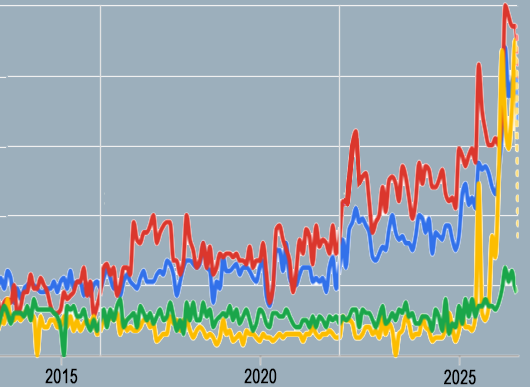
In my work as a Defamation Expert Witness lately, I have seen an uptick in inquiries about my services. After checking Google Trends, I can see that this was not merely an anecdotal experience: searches for defamation lawyers and defamation attorneys are on the rise, as well as some related search topics.

The question is, why are defamation attorney searches rising?
I believe there is a combination of factors at work:
- There have been a number of prominent people involved in high-profile defamation lawsuits in recent years. These include:
- In 2019, E. Jean Carroll sued Donald J. Trump for defamation and emotional distress over a denial that he had sexually assaulted her. He appealed, and she prevailed and was awarded $5 million in damages for the sexual abuse and defamation verdict on June 29, 2026.
- E. Jean Carroll filed a second lawsuit when Trump subsequently defamed her in other comments, and she was awarded $83.3 million for him making the defamatory comments.
- President Donald J. Trump also sued The New York Times for defamation, although this lawsuit was thrown out by the judge in July of 2026.
- Trump has also sued the BBC for $10 billion for alleged defamation over January 6, 2021, broadcasts that involved undisclosed edits of a speech he gave that day.
- In 2024, Blake Lively filed a lawsuit against Justin Baldoni arising from their work together on the film, It Ends With Us, for alleged violations of U.S. Federal and California State Laws, including retaliating against her for reporting sexual harassment and workplace safety concerns. Baldoni countersued, alleging extortion, defamation, and invasion of privacy.
- In 2022, Johnny Depp sued Amber Heard for $50 million over a 2018 op-ed she wrote, and Heard filed a $100 million countersuit. Depp prevailed in the case.
- In 2018, Sandy Hook Elementary School victims’ families successfully sued radio host and conspiracy theorist Alex Jones for defamation, totaling over $1.4 billion in judgments after he falsely claimed the 2012 mass shooting was a staged hoax.
- Rapper Afroman (Joseph Edgar Foreman) won a March 2026 jury trial where an Ohio sheriff’s office unit had sued him for defamation and using their likenesses after he mocked their 2022 raid on his home in music videos.
- In 2026, a federal judge awarded Hunter Biden $1.7 million in a defamation lawsuit against former Overstock.com CEO Patrick Byrne. The judgment included $1.7 million in punitive damages and $1 in nominal damages after Byrne fabricated claims that Biden solicited an $800 million bribe from Iran.
- Publicity around high-profile defamation lawsuits helps educate the public about what is unacceptable speech that creates lawsuit liability. People are not always aware that free speech has limits.
- It is possible that the prominent defamation lawsuits with very large monetary damage awards have awakened people’s interest in defamation lawsuits and have attracted people to consider suing for defamation they have experienced.
- Overall, there seems to be an increased perception that people can say whatever they wish as a First Amendment freedom of speech right. (Obviously, the perception is wrong since that right has some limits placed on it.)
- The trend for people to use internet information sources for finding products, services, and companies has only continued to grow, so it is possible that people’s sensitivity to being defamed online has grown even stronger.
I have a theory that there may be additional, hidden dynamics at work in these sharply-increasing trendlines as well. It is very possible that changes in search engine algorithms and the inclusion of generative AI in search results may be driving more online reputation damage in recent years. The upticks in defamation lawyer searches started happening as AI chatbots began gaining usage as well, and the AI usage and defamation law searches have risen in tandem.

It is difficult to attribute the increased interest in defamation attorneys to changes in search algorithms and AI responses. For one thing, Google took very definitive action against many reputation attack sites some years ago (such as Ripoff Report, ComplaintBoard, Pissed Consumer, and mugshot websites), and those have not particularly recovered rankings in search results. The AI companies have been rapidly mitigating how information is presented about individuals and companies to avoid defamation liability, too, but there is no question that the most-used AIs can surface defamatory imputations originating from source materials as well, including very untrustworthy social media sources. But defamatory AI responses have played a part in multiple different defamation cases that I have worked on as an expert witness. There is some likelihood that this could be playing a role in the increasing interest in defamation litigation, since AI may be distilling and focusing answers about subjects on both the best and worst things known about them.
The fact that people are increasingly searching for Defamation Attorneys or Defamation Lawyers is indicative of searcher intent — it is likely that it signals that people are considering hiring a law firm to conduct a defamation lawsuit for them.
It would be further revealing to know the conversion rate for those people who conduct these searches and who then follow up by contacting defamation law firms and hire them. One can reasonably expect that many people who inquire about such legal services are in something of a research or exploratory stage, and they might lose interest once they hear about the costs.
However, the high-profile cases and associated press coverage of them are likely to increase the interest of law firms in pursuing defamation/libel/slander cases as well. I have only run across a small number of firms that may agree to handle a defamation lawsuit on a contingency basis, so this is a rarity. Obviously, the potential scope of damage awards for defamation cases will determine how aggressively potential litigants and law firms will pursue such matters, but the press coverage conveys a perception that there could be significant rewards for those who have good cases.
The reality of pursuing defamation tort cases is that the potential damages involved may be fairly limited according to the jurisdiction involved. Defamation cases also often hinge on details like the date the defamatory imputations became public, the amount of exposure in terms of how many people witnessed it, and how long has elapsed before a complaint can be filed — defamation is often subject to statutes of limitations. For these reasons, defamation cases can often be framed as tortious interference, invasion of privacy, and intentional infliction of emotional distress.
Of course, research indicates that the involvement of expert witnesses helps increase damage awards and settlement values in lawsuits. So, attaining the high damage awards in defamation cases often involves hiring qualified expert witnesses to help frame various damage models that can come into play. Expert witnesses provide objective calculations, establish complex causation, and can help legitimize non-economic pain and suffering. Legal studies and insights from organizations have consistently demonstrated that specialized testimony from experts directly impacts financial outcomes in court and during negotiations.
